
Table of Contents
Meta has released Muse Spark Open, an open-weight AI model built for coding, tool use, and extended agent workflows. Meta has optimized it for two Apple M5 Ultra Mac Studios using MLX and tested local workflows that modify iOS software and operate video-editing tools.
Muse Spark Open is Meta’s most capable U.S. open-weight model to date; it has 816 billion total parameters, activates 42 billion for each token, and supports a context window of 1 million tokens, with text, image, video, and audio inputs.
The release combines a mixture-of-experts architecture with downloadable weights, broad inference-engine support, and a custom license that permits many commercial uses for free while imposing separate terms on larger model-serving businesses. This gives developers a choice between hosted APIs and running the model on their own hardware.
How an 816B-Parameter Model Runs Locally
Muse Spark Open uses a mixture-of-experts transformer that routes each token through eight of 256 experts. That allows it to draw on a large pool of learned parameters without using all of them for every generated token. The architecture also includes a perception encoder for multimodal inputs, while the model's output is text.
Activating 42 billion parameters reduces the computation needed per token, but the remaining weights still have to be stored. Meta distributes both BF16 and lower-precision NVFP4 versions. Its model card lists GPU-memory requirements of at least 700GB for NVFP4 and 2TB for BF16.
For the two-Mac configuration, each M5 Ultra's integrated GPU can access up to 512GB of unified memory, giving the pair roughly a terabyte combined. Meta cites the chip's 1.2TB-per-second memory bandwidth as sufficient to read the subset of weights needed for each token. Unified memory makes the machines' memory available to the GPU rather than restricting inference to a separate pool of graphics memory.
Meta tested the setup with Muse Code powered by Muse Spark Open. The company says its on-device workflows produced bug fixes, features, and a full build for Ice Cubes, an open-source Mastodon client for iOS. Another workflow operated DaVinci Resolve, reviewing footage frame by frame to select moments and crop them vertically.
Agent and Coding Benchmark Results
Meta's published evaluation results use Muse Spark Open's highest reasoning-effort setting, xhigh. In its comparison, the model scored 61.8 on JobBench and 89.2 on MCP-Atlas, ahead of the other listed models on both tests. It scored 80.4 on OSWorld Verified, compared with 84.8 for Kimi K3.
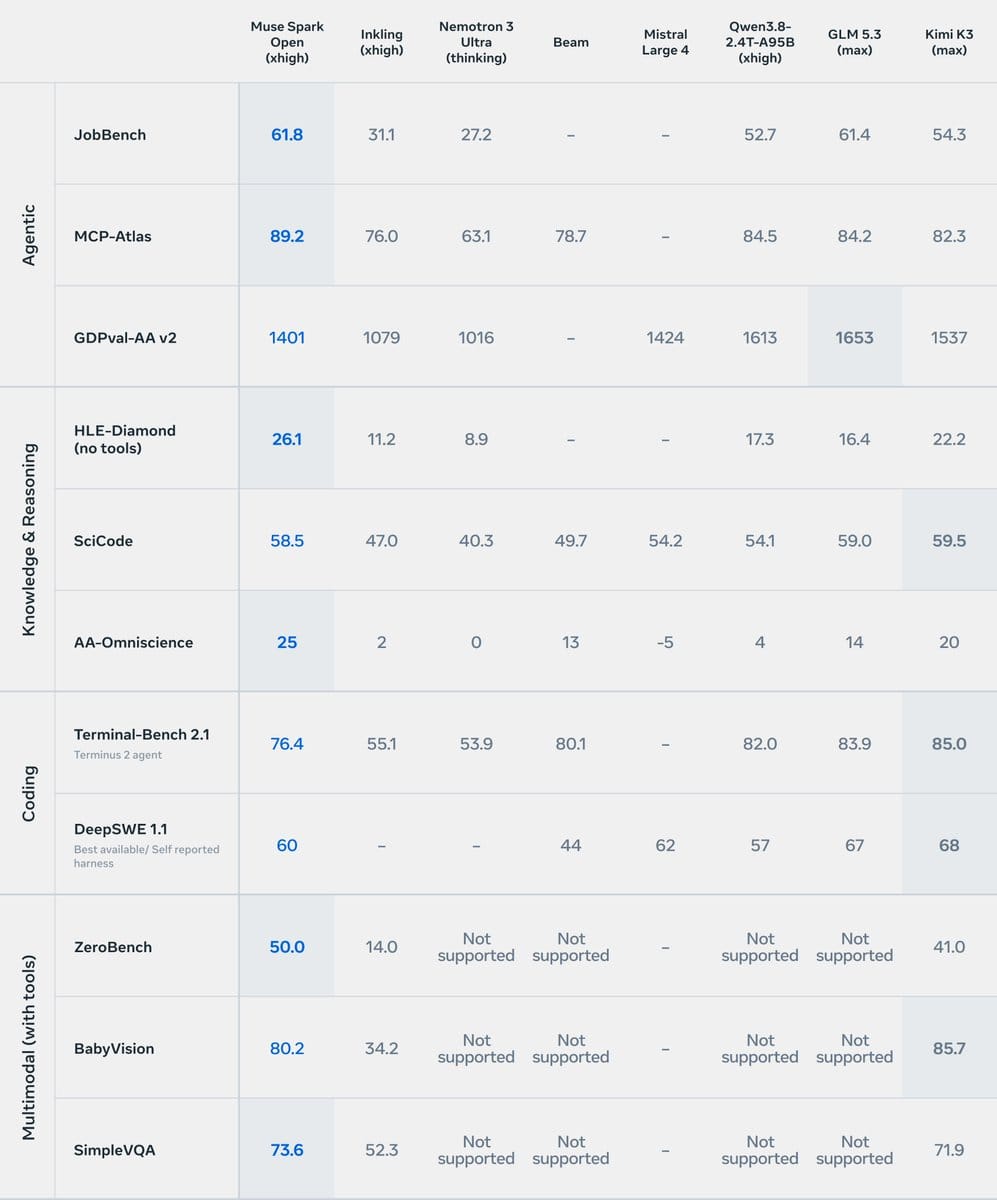
The coding results show a different ordering. Muse Spark Open scored 76.4 on Terminal-Bench 2.1 using the Terminus 2 agent, below Kimi K3's 85.0 and GLM 5.3's 83.9. It scored 60 on DeepSWE 1.1 using its preferred harness, compared with 68 for Kimi K3 and 67 for GLM 5.3.
Developers can adjust reasoning effort to low, medium, high, or xhigh. Meta recommends high or xhigh for complex coding and agent tasks, with lower settings intended for faster, shorter responses. The million-token context window determines how much material the model can take into account at inference, including conversation history and other inputs.
Inference Support and GPU Optimizations
The supported software stack includes SGLang, vLLM, TensorRT-LLM, Hugging Face Transformers, Apple MLX, llama.cpp, and Unsloth, with optimizations for AMD, Apple, Intel, and NVIDIA hardware. Developers can further fine-tune the model using PyTorch's TorchTitan.
Muse Spark Open also ships with auto-tunable Helion GPU kernels in SGLang. Meta reports kernel-level speedups ranging from 1.03 to 3.95 times on NVIDIA and AMD GPUs, alongside a 3% end-to-end improvement on AMD MI350. The larger figures apply to individual GPU operations; the 3% figure measures the overall inference improvement on that AMD platform.
For the open-weight release, Meta added safety post-training and evaluated the model against its Meta Superintelligence Scaling Framework. The company says it met the framework's release thresholds. Its model card covers content safety, agentic risk, privacy, and preparedness, and recommends safeguards tailored to the tools and actions available in a deployed system.
Where to Get the Model and What the License Allows
Hosted API access is available through Baseten, Fireworks AI, Groq, Modal, Nebius, OpenRouter, and Together AI. Downloadable weights are available through Amazon SageMaker AI, Google Cloud Model Garden, Microsoft Foundry Models, and Meta's Hugging Face collection.
The Muse Model License permits use, modification, fine-tuning, distillation, and redistribution, subject to its conditions and usage policy. Products or services using the model or derivatives must display "Built with Muse Spark Open" in their interface or accompanying documentation, website, or settings menu.
A separate agreement is required when a licensee or its affiliates offer model-as-a-service access and their aggregate gross revenue exceeds $20 million in any consecutive 12-month period. That provision does not apply to internal use, research, or commercial activity outside model-as-a-service, including using the model to power features within a different kind of product.
For Apple-silicon deployment, Meta directs developers to MLX's language-model tooling, which pulls the weights directly from Hugging Face.